

To clean a ceiling fan, follow its owner’s manual to turn off the power and wait for the blades to stop. If you can comfortably reach from the floor, gently slide an old pillowcase or a microfiber cloth along each blade to collect the dust. Check the manual before using a damp cloth or cleaner on sticky blades. If you would rather hand the job off, Ladybug’s deep cleaning checklist lists ceiling fans.
This guide covers the safe way to start, the pillowcase method, how to handle sticky blades and light kits, and how often to repeat it.
Key takeaways
- Switch the fan off and let the blades stop before you touch them.
- Trap the dust with a pillowcase or microfiber cloth instead of flicking it into the air.
- Use light pressure. Fan makers warn that heavy pressure can damage blades.
- Put cleaner on the cloth, never directly on the fan.
- Skip abrasive cleaners, alcohol and baby wipes, which can harm the finish.
What should you do before you clean a ceiling fan?
Follow your fan’s manual to switch off its power and prevent it from starting while you work. Wait until the blades have fully stopped. Kichler’s care guide says to switch off the power and wait for the blades to stop spinning, and its warnings include never working on a fan while it is running. If your fan has a light, Hunter adds that the light should not be hot to the touch before you start.
Dust drops as you work, so cover the furniture or floor under the fan with an old sheet, as Hunter suggests. Plan to do the fan before the rest of the room, so the dust it drops gets cleaned up in the same pass. Our deep cleaning checklist for Las Vegas homes puts the fan, vents and baseboards on one whole-home list.
How do you clean ceiling fan blades without making a mess?
Use the pillowcase method for dusty blades. Hunter’s guide describes slipping a large pillowcase, longer than the blade, over one blade at a time and gently sliding it toward you, which wipes the top and bottom and traps the dust inside. Shake the pillowcase out outside before you wash it.
AI-generated illustration of household cleaning equipment; not an actual Ladybug home or job.
Hunter describes an extendable duster with a flexible head as an option for some fans. Use it only if you can comfortably reach from the floor without stretching or pressing on the blades. Otherwise, leave the fan alone and discuss access when you book a professional clean.
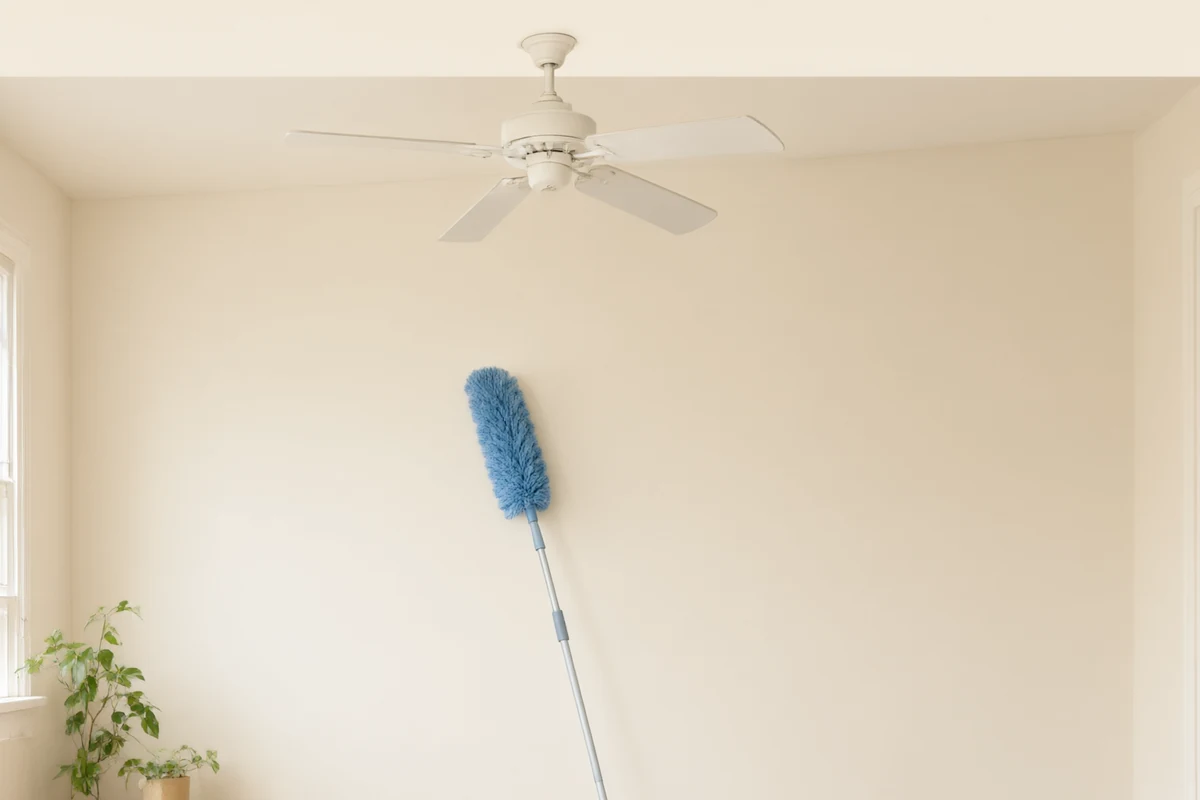
AI-generated illustration of household cleaning equipment; not an actual Ladybug home or job.
Keep the pressure light
Press gently. Hunter warns that too much pressure on the blades “could cause the blades to break,” and Kichler’s warnings say not to apply pressure on the blades.
Clean both sides
Dust collects mostly on top, but Hunter says to clean both sides to keep the fan balanced and moving air well.
How do you clean sticky or greasy ceiling fan blades?
Check your fan’s care instructions first. The CDC’s home-cleaning guidance says to choose a product suitable for the surface and follow its label. Where your fan’s manual allows it, use a soft microfiber cloth dampened with warm water and a few drops of mild dish soap, then dry the blades with a clean cloth. Hunter describes this for sticky blades, and its guidance is to put the solution on the cloth rather than spraying the fan, so moisture does not get into the motor housing or light kit.
Kitchens often need this step, because grease makes dust stick. If the fan is above a cooking area, the kitchen deep clean guide covers the rest of the room.
Avoid anything harsh. Kichler warns that abrasive or toxic cleaners, alcohol and baby wipes may damage a fan’s finish. Your owner’s manual may name the products your blade material can take, so check it before using anything other than mild soap and water.
How do you clean the fan body and light kit?
Dust the motor housing, canopy and blade arms with the same dry cloth. Kichler lists the canopy, downrod, motor housing and blade arms as the metal parts to wipe. For glass shades, turn the light off and let it cool, then follow your fan’s instructions to remove the glass if it comes off, wash it in warm water with a little mild dish soap, and dry it fully before putting it back. Hunter and Kichler both describe washing glass shades this way.
Do not take the fan apart beyond that. Hunter says most routine cleaning can be done without removing the blades or disassembling the fan. Kichler describes taking blades off for a deeper clean and says to turn the power off at the electrical box first. If you are not sure how your fan comes apart, leave it and check the manual.
How often should you clean a ceiling fan?
Hunter’s FAQ suggests dusting most fans every 1 to 3 months and doing a deeper clean every 3 to 6 months. It says kitchens, homes with pets and households with allergies may need it more often. Your fan’s maker may give its own schedule, so check the manual.
A good moment to dust the fan is when you switch its direction for the season, which Kichler suggests pairing with a clean.
Where does a ceiling fan fit in a whole-home clean?
Start with the fan, then work down. Dust that falls from the fan lands on blinds, baseboards and window sills, so do the fan first and finish with the floors. Our guides to cleaning blinds, cleaning baseboards and cleaning window tracks follow the same dry-first approach.
What does Ladybug’s checklist say about ceiling fans?
Ladybug’s cleaning checklist lists “Dust Air Vents & Ceiling Fans” on its Standard Cleaning, Deep Cleaning and Move-In/Out tabs. On the Standard tab the item is marked “if applicable.” The page explains that extra-detail items receive more attention and that actual scope depends on the home’s condition. If you have a fan you are not comfortable reaching, mention it when you book.
FAQ
Can you clean a ceiling fan without a ladder?
Sometimes. An extendable duster may work if you can comfortably reach from the floor without stretching or pressing on the blades. Follow your fan’s care instructions. If you cannot reach comfortably, leave it alone and discuss access with a professional.
Is it okay to spray cleaner on a ceiling fan?
Hunter’s advice is to spray the cloth, not the fan, so moisture does not reach the motor housing or light kit. Kichler also calls for a damp, not too wet, cloth with mild dish soap.
Should I take the blades off to clean them?
Usually not. Hunter says most routine cleaning does not require removing the blades. Kichler describes removing blades only for a deeper clean, with the power off at the electrical box. Follow your own fan’s manual.
Does Ladybug dust ceiling fans?
Ladybug’s checklist lists “Dust Air Vents & Ceiling Fans” on the Standard, Deep Cleaning and Move-In/Out tabs, and the page notes that actual scope may vary based on home condition.
Want the fans off your list?
Tell Ladybug about your home and pick the service that fits. Get an Instant Quote or call (702) 287-7474.
Sources
- Hunter Fan, “How to Clean and Maintain Your Ceiling Fan”, read 2026-11-19
- Kichler Lighting, “Cleaning a Ceiling Fan”, read 2026-11-19
- Ladybug Cleaning Co., “Our Cleaning Checklist”, tabs read 2026-11-19
- CDC, “When and How to Clean and Disinfect Your Home”, read 2026-11-19
Related guides
- how to clean a ceiling fan
- Las Vegas
- ceiling fan cleaning